 Gregory Goswell
 Ashley Lyon
The word selah is prominent in the Psalms, occurring 71 times (as well as 3 in Habakkuk)— but what does it mean?




The word selah is prominent in the Psalms, occurring 71 times (as well as 3 in Habakkuk)— but what does it mean?

Is it dangerous to accept changes to our language? Does doing so amount to moral relativism? I once had to stand as a young man in front of an adult Sunday school class and wait for ten minutes (it felt that long, anyway) while a much older man in...

Watch Mark Ward’s full interview with Jonathan Leeman on the theology of love. Love is the most important commandment in the Bible. And the second most important. On love for God and neighbor hang both testaments. And at the center of the Bible...

Reformation Day is October 31. In remembrance, keep reading to explore with David P. Barshinger how the Reformers offer us a model for Bible study. (Or dig deeper into Reformation exegesis with Reading Scripture with the Reformers or The Martin...
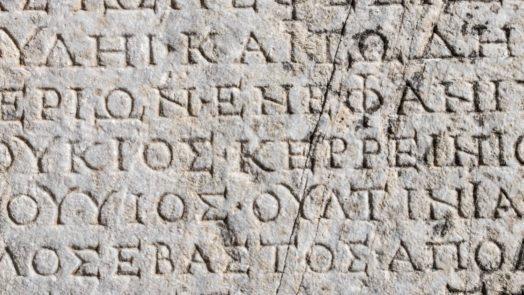
This is the second article in a two-part series dealing with the common myth that Greek is the most precise language known to mankind. (Article one here.) I’d like to look at a few more examples of imprecision in the Greek of the New Testament...
Faith is one of those fancy Christian words we can find ourselves using a lot without truly understanding what it means. To many in American culture, “faith” is the opposite of reason and is best represented by a blindfold or reckless leap. For many...

James Strong’s 1890 Exhaustive Concordance of the Bible is one of the most frequently cited Bible study resources out there—perhaps because it is freely available in many places online. But its dictionary portion is often misused. I humbly offer...

The Dead Sea Scrolls don’t interest only academics and scholars. Many average Christians have questions, too. Read on for the answers to the most common questions! What are the Dead Sea Scrolls? How were the Dead Sea Scrolls discovered? How...

Even elementary Bible readers quickly recognize that the Bible includes an Old Testament and a New Testament. For beginning readers, these two great divisions might seem to be equivalent to Part I and Part II. As beginners grow in their...
In order that Satan might not outwit us. For we are not unaware of his schemes. (2 Cor 2:11 NIV) One of the Christian’s defenses against the devil’s stratagems is prior awareness of his purposes and methods. In 2 Corinthians 2:5–11, we discover...
Your email address has been added
 Mark Ward
 Bible Study Magazine
 Nathaniel J. Erickson
 Peter Krol
 Drew Longacre
 Brian Collins
 Murray J. Harris